What Is Zoho? A Guide to the Company and Popular Tools
If someone has mentioned Zoho in front of you and you nodded along without really knowing what Zoho is, you are not alone. It is one of those names that is used a lot in business circles, but only a few people can explain it properly.
As someone who has managed business operations for years and founded Botventr, I know how tricky it can be to choose the right tools for your business. This guide breaks down everything you need to know in simple terms so that you can decide if Zoho is actually right for your business.
What is Zoho?
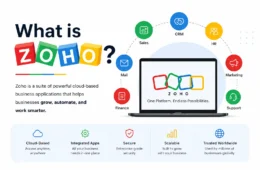
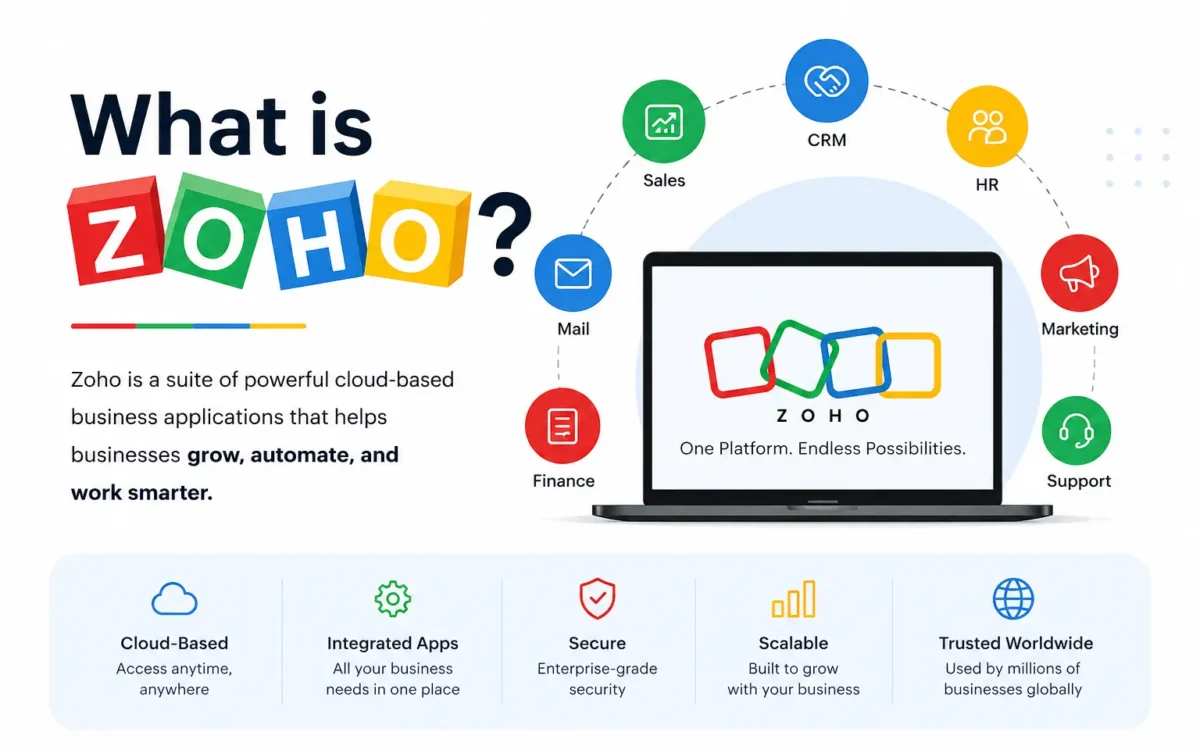
Zoho is a company that builds software to help businesses run their daily operations, including sales, accounting, email, HR and customer support. It works similarly to Microsoft Office or Google Workspace, offering businesses productivity tools that cover everything from sales and marketing to finance, legal, IT and analytics.
Across its full range, Zoho has over 150 million users worldwide. It offers more than 55 products covering sales, marketing, support, collaboration, finance, and recruitment. Which is why the name comes up so often, no matter what part of a business someone works in.
What is Zoho used for?
Zoho is not a single tool that works in one particular area. Thus, the answer to this question depends on which part of Zoho you want to use. Here is how it breaks down by real business needs, instead of a long list of applications:
- Sales and customer relationships: Most businesses need a way to keep track of leads, remember what was said in the last call, and know which deals are close to closing. That’s usually handled through Zoho CRM, and it’s often the first thing people set up when they start with Zoho.
- Accounting and invoicing: Getting invoices out, keeping the books straight, and staying on top of tax filing is another area every business has to deal with one way or another. Zoho Books covers most of that, and it handles multiple currencies well too, which matters if you’re billing clients in more than one country.
- Customer support: Every business needs a way to make sure customer questions and complaints don’t quietly disappear into someone’s inbox. That’s the gap Zoho Desk fills, keeping every ticket logged and tracked until it’s actually resolved.
- HR and hiring: Bringing new people on board, tracking applicants, running onboarding properly, this is where a lot of small businesses are still stuck using spreadsheets. Zoho People and Zoho Recruit are built to take over that process.
- Inventory and operations: Keeping stock levels accurate and project timelines on track is its own ongoing job. Zoho Inventory and Zoho Projects are the tools most businesses lean on for that.
- Email and communication: Plain business email, the kind running on your own domain instead of a free personal account, comes through Zoho Mail, along with basic calendar and collaboration tools.
None of these areas is locked to just one app either. It is common for a business to combine two or three Zoho tools to cover one part of their business operation. Sales and support often end up working together, for instance, since a support ticket can turn into a sales conversation pretty quickly.
The Real Reason Businesses Choose to Switch Zoho Products:
What ties all this together is that most businesses using Zoho were paying for four or five separate tools before switching. One subscription for email, another for CRM, another for accounting, another for support. Whereas Zoho lets businesses run most of that from one connected system, resulting in cutting both cost and the daily hassle of switching between disconnected apps.
What are Zoho’s most popular products?
Most teams don’t jump straight into the full Zoho setup. Instead, they usually pick one tool to fix a specific headache, then look at the rest of the lineup later on. A handful of core apps drive most of their business:
- Zoho CRM: This tracks your leads and deals so your team stops losing track of sales in messy spreadsheets.
- Zoho Books: Deals with your invoices and taxes. It manages multiple currencies easily, making it great for invoicing overseas clients.
- Zoho Desk: Keeps customer support organized by turning incoming emails into trackable help tickets.
- Zoho Mail: Provides professional business email on your own domain without charging big provider prices.
- Zoho One: The full package that links virtually all their tools together under a single plan.
You do not need to buy all of these together. Just pick the single app that provides solution to your biggest problem and then add more as your business expands.
Is Zoho Free?
Not entirely, but you can get away with using parts of it without spending money.
Zoho itself is not a single free software. Instead, it is a huge suite of tools. The good news is that several of their most popular apps have solid free plans.
If you run a small business, here is what you can actually get for free:
- Zoho CRM: Zoho CRM offer a free forever access for up to three users and that too without a credit card sign up. Rest a subscription is required for additional users that varies between $14 and $65 per user depending on the choice of plan and billing frequency.
- Zoho Invoice: Fully free invoicing, expense tracking, and quote software built specifically for micro-businesses and freelancers.
- Zoho Mail: Gives free email hosting for up to five team members. Includes secure, ad-free business email hosting using your custom domain (web-only access).
- Zoho Projects: Free for up to 3 users and 2 active projects. It allows small teams to manage basic tasks.
These free versions work fine when you are just starting out. But they do have hard limits. The moment you need custom reports, automated emails, or more user accounts, you will have to pay.
If you end up needing all their tools at once, look at Zoho One. It packs their entire software suite into a single monthly fee per employee. Pricing sits around $37 a month per worker if you license your entire company, or roughly $90 a month if you only buy seats for a few specific employees.
Why is Zoho so Famous?
A few things built Zoho’s reputation, and they are worth understanding on their own.
Price: Zoho’s tools are affordable for small businesses making it a great alternative to products from Salesforce, Microsoft, or other established competitors.
Range: With more than 80 apps on offer, Zoho has been compared to a Swiss army knife, because there is almost no business function it does not have some kind of tool for. Few companies attempt to cover this much ground under one name.
Zoho One: This is the bundle version of the entire suite, and it is probably the single biggest reason people bring up Zoho in conversation. Instead of buying apps one at a time, a business pays one flat fee per employee and gets access to the full range of tools. No other company offers this much software at this kind of pricing, and it is a major reason so many small and mid-sized businesses have adopted Zoho over the years.
Independence: The fact that Zoho has grown without outside investors sets it apart from most software companies of its size, and it plays a real role in why the pricing has stayed accessible over time.
Where Zoho actually falls short – Key Disadvantages of Zoho
No honest guide to Zoho would leave this part out, as the platform is not perfect for everyone. Most complaints from real users are related to the user interface and how complex the system can feel at first.
- Some people criticize Zoho for having a less modern look compared to newer competitors.
- Many long-term users describe the platform as harder to pick up than expected, especially once they move past the basic features into anything more advanced.
- Because of this complexity, switching to Zoho from simpler systems like Google can feel less intuitive for daily use and cause temporary frustration or lost productivity.
However, these issues do not necessarily mean the software is flawed. In reality, a lot of user frustration simply comes from trying to configure advanced features without proper guidance during the setup stage.
How to avoid these problems
Because the setup stage matters far more than people expect going in, getting proper support makes a huge difference.
To bypass the learning curve, many businesses choose to work with a certified Zoho partner during setup, ensuring the system gets built correctly from the start instead of needing to be fixed later.
Is Zoho only for small businesses?
No, though it did start out that way. Zoho was originally built with small businesses in mind, and its per user pricing still favors smaller teams over large enterprises. A team of five will pay a fraction of what a company of five hundred pays for the same tools.
That said, Zoho has grown well beyond small business use. Larger companies across banking, insurance, manufacturing, and other industries now use Zoho for specific departments or, in some cases, across their entire operation. The platform scales, but it is still most commonly associated with small and mid sized businesses, because that is where its pricing and simplicity offer the clearest advantage over enterprise focused competitors.
Who is behind Zoho and can you actually trust it?
This is a fair question to ask before you build any part of your business around a software company, and it is one most articles about Zoho skip entirely.
History: Who is behind Zoho?
Zoho did not start as Zoho. The company was founded in 1996 as AdventNet in New Jersey. It started with building network management software for telecom clients and stayed profitable in that space for close to a decade. The founders also brought support from the family, which provided the business a room to grow on its own terms rather than chasing funding from outside.
Around the mid-2000s, the company shifted towards cloud-based, browser-accessed software and moved in that direction. In 2009, it officially took the name Zoho Corporation, headquartered in Chennai, India.
The part worth knowing is that Zoho has never taken outside venture capital funding. It remains privately owned and independently held to this day. Founder Sridhar Vembu is well known in the industry specifically for turning down venture capital money at a time when almost every fast-growing software company was raising rounds one after another.
Your Story: Can I trust Zoho?
Yes. Zoho is a trustworthy company mainly because of its ability to take independent decisions and continuous research and development.
But why does this matter to you as someone deciding whether to trust the platform? A company funded by outside investors usually faces pressure to grow fast, hit numbers every quarter, and eventually sell or go public. Zoho has never had that pressure, and that is why I personally recommend Zoho as a trustworthy company. It has grown using its own profits since the beginning, which means its decisions are driven by what works in the long term, not by what looks good to shareholders next quarter.
On the privacy side, Zoho states it does not run an advertising revenue model in any part of its business, including its free products. That is a meaningful difference from platforms that give away free tools in exchange for using your data to sell ads. And on the product side, the company has said it puts 50 to 60 per cent of its revenue back into research and development, which is one reason the product range keeps expanding year after year.
Final Thoughts: Is Zoho Actually Worth Using?
For a small to mid sized business, the answer is yes. It costs a lot less when compared to competitors and covers almost all your core business needs, which saves serious time by cutting out repetitive manual tasks.
However, the setup process is what matters most. If you are thinking about getting help with your setup, check out our guide on how to find a Zoho partner to choose the right team for your project.
Zoho offers a massive amount of customization. Figuring out the right settings on your own often takes much longer than you might expect, especially once you move past simple features. Setting things up properly at the start determines whether you actually get your money’s worth down the line.